
Beyond Vacancy™ Season 1 · Episode 1
Published by Shalini Sood beyondvacancy.co.in
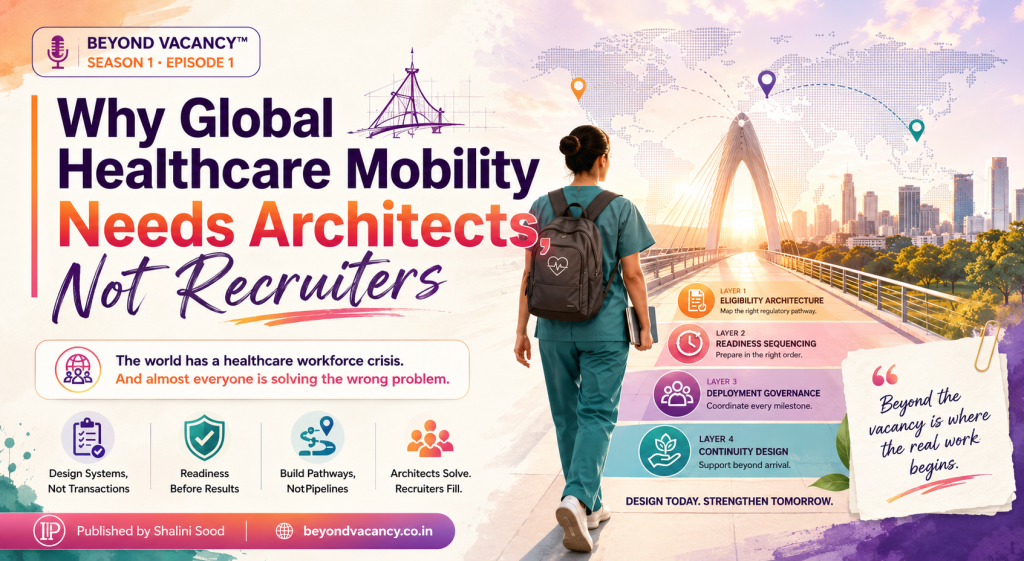
The world has a healthcare workforce crisis. And almost everyone is solving the wrong problem.
The dominant response has been to recruit faster, source wider, and process more profiles. Hire more recruiters. Build bigger databases. Move more CVs. The assumption is that the problem is one of speed and volume.
It is not.
The crisis in global healthcare workforce mobility is a system design failure. And you cannot fix a system’s design failure by adding more people to a broken system. You fix it by redesigning the system itself.
That distinction — between filling a vacancy and designing a system — is the difference between a recruiter and an architect. And right now, the industry has thousands of the former and almost none of the latter.
The Problem Nobody Is Measuring
Consider what actually happens in a typical international healthcare recruitment project.
A hospital in Norway needs 20 nurses. A recruitment agency in India begins sourcing. Profiles are submitted. Interviews are scheduled. Offers are made. And then — somewhere between offer acceptance and deployment — the process begins to fall apart.
Documentation submitted out of sequence. Language certifications not at the required level for the destination regulatory body. Licensing applications filed before the prerequisite steps are completed. Candidates who said yes in April haven’t boarded a flight by October. The hospital is still short-staffed. The agency is back to sourcing.
At The Indah People, we have studied this pattern across multiple international markets — the UK, Germany, Norway, Japan, the UAE, and Australia. The breakdown point is rarely the candidate. It is almost always the architecture around the candidate.
This is what happens when workforce mobility is treated as a transaction rather than a system.
What a Mobility Architect Actually Builds
A Global Healthcare Mobility Architect operates at a completely different level of the problem.
The recruiter’s question is: “Can we find a nurse for this vacancy?”
The architect’s question is: “Why does this vacancy keep appearing — and how do we build a system that resolves it sustainably?”
One is reactive. The other is structural.
In practice, architectural thinking means designing across four interconnected layers that most recruitment processes never complete:
Layer 1 — Eligibility Architecture
Not merely verifying that a candidate holds a nursing degree, but mapping the precise regulatory pathway that degree activates in the destination country. What specific licensing body governs that credential? What is the exact sequence of recognition, examination, and registration? What documentation is required at each stage, and in what order? This mapping must happen before any offer is extended — not after.
Layer 2 — Readiness Sequencing
Building a structured preparation timeline that moves the candidate through language certification, credential verification, compliance documentation, and regulatory alignment in the correct sequence for the specific destination. The sequence matters as much as the steps. A candidate who takes the IELTS before completing credential verification may have to repeat the process. A candidate who applies for NMC registration before their OSCE preparation is complete will face delays that unravel the entire timeline.
Layer 3 — Deployment Governance
Coordinating the employer side with the same rigor applied to the candidate side. This means offering governance — ensuring that what is offered can be delivered. Visa processing with defined milestones and escalation protocols. Pre-departure orientation that is substantive rather than procedural. These are not administrative tasks. They are architectural ones.
Layer 4 — Continuity Design
The work begins after a nurse arrives. Post-deployment monitoring. Issue resolution support. Workforce stability tracking. Career pathway conversations. A nurse who leaves a placement within six months is not a successful deployment — it is a system failure that happened to be delayed. Continuity design prevents that failure before it occurs.
Most recruitment processes manage one of these layers. Some manage two. Very few manage all four with equal rigor. That gap is where the industry’s billions in failed deployments disappear.
Why This Matters Now More Than Ever
The demographics of global healthcare are not waiting.
By 2030, the World Health Organization projects a shortfall of 10 million healthcare workers globally. Europe’s nursing vacancy rates are already at historic highs. Japan’s healthcare system is facing a structural deficit that domestic training cannot resolve. Australia and New Zealand are competing aggressively for qualified nurses from international markets.
At the same time, India is graduating approximately 150,000 nurses annually — clinically trained, English-proficient, internationally eligible, and motivated to build global careers.
The corridor exists. The talent exists. The demand exists.
What is missing is the architecture to move talent through that corridor reliably, compliantly, and at scale.
This is not a recruitment challenge. It is a workforce engineering challenge. And it requires architects.
The Beyond Vacancy™ Principle
The name BeyondVacancy™ was chosen deliberately.
Beyond the vacancy is where the real work begins. Beyond the urgency of the immediate opening. Beyond the transactional pressure of filling a position. Into the structural territory of asking: why did this vacancy exist? What system failure created it? What architecture would prevent it from appearing again?
That is the territory this platform occupies.
At The Indah People, our operating principle is Readiness Before Results. We measure success not by profiles submitted, but by joining ratio, time-to-deploy, compliance score, and retention at twelve months. Because the vacancy is not the destination. A stable, structured, compliant healthcare workforce is the destination.
And you need architects — not just recruiters — to build it.
*What would change in your organization’s international hiring if you brought in one architect for every ten recruiters? *
*Share your perspective in the comments. *
About the Author
Shalini Sood is a Global Healthcare Mobility Architect and Founder of The Indah People — an international healthcare workforce advisory operating across Europe, GCC, Japan, Australia, and New Zealand. With over 11 years of experience designing cross-border workforce systems, she writes about workforce architecture, career mobility, and the future of global healthcare talent at beyondvacancy.co.in.
Connect on LinkedIn: linkedin.com/in/shalinisood
Explore The Indah People: theindahpeople.in
Beyond Vacancy™ is a knowledge platform on global healthcare workforce mobility.
Series: Season 1 — Designing Global Healthcare Mobility
Next: Episode 2 — Healthcare Has a Mobility Problem, Not Just a Hiring Problem

 Beyond Vacancy™