A room full of talent is not a workforce. It becomes one only when a system can turn human capability into usable capacity.
We have become remarkably comfortable counting people. Headcount. Qualifications. Vacancies. Availability. Migration. Employment. We put the numbers into dashboards, compare supply with demand and then declare a workforce shortage when the equation doesn’t balance. But what if the equation itself is wrong?
A hospital can have thousands of qualified professionals and still be unable to staff the services it needs. A country can have a large healthcare talent pool and still experience critical shortages. An organisation can employ capable people and still struggle to deploy them where they matter most. The people exist. The talent exists. The workforce may not.
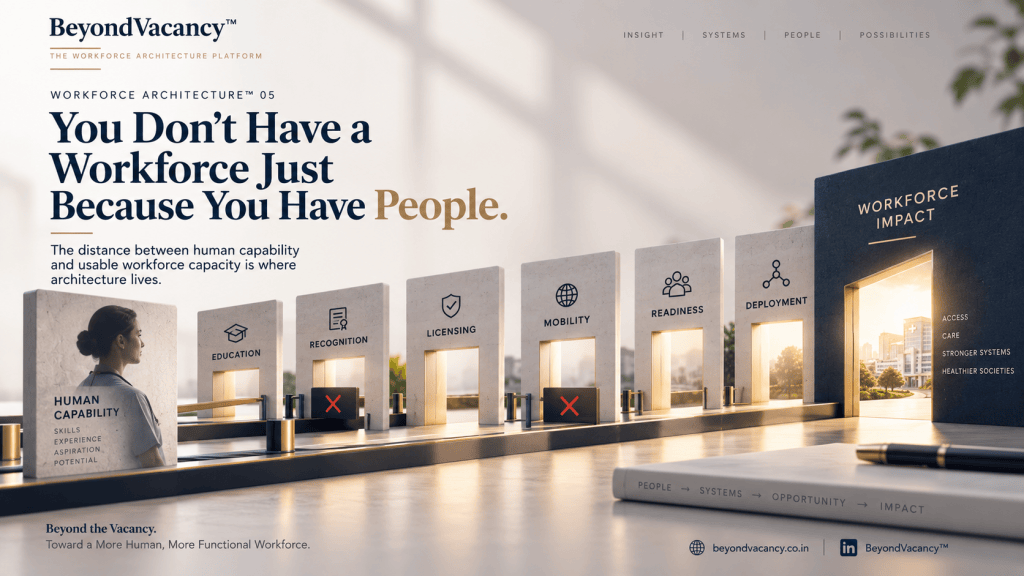
That distinction has increasingly occupied my thinking because of a pattern I have seen across workforce systems: we routinely confuse human capability with workforce capacity. They are related, but they are not interchangeable. A professional can be qualified but not licensed where they are needed; available but unable to move; willing but unable to relocate; experienced but not ready for a particular environment; employed but underutilised. The person is present. The capability is real. Yet the system cannot convert it into the workforce outcome it requires.
And that is where the conversation gets interesting.
Think about a healthcare system struggling to fill a specialist role. The obvious question is, “How many specialists are available?” A better question is, “How many can actually become deployable specialists here, now, under the conditions this system requires?” Suddenly, qualification is only the beginning. Recognition, licensing, mobility, readiness, language, geography, onboarding, family realities, incentives and institutional capacity all enter the equation. The apparent talent pool starts shrinking—not because people disappeared, but because the system cannot convert potential into deployment.
This changes the meaning of a “talent shortage”. Sometimes there genuinely aren’t enough people. But sometimes the people are there and the architecture around them is creating the shortage. A nurse blocked by licensing. A specialist unable to cross a regulatory boundary. A graduate whose education does not align with emerging demand. An experienced professional who is available but cannot navigate the pathway into employment. These are not simply recruitment problems. They are workforce conversion problems.
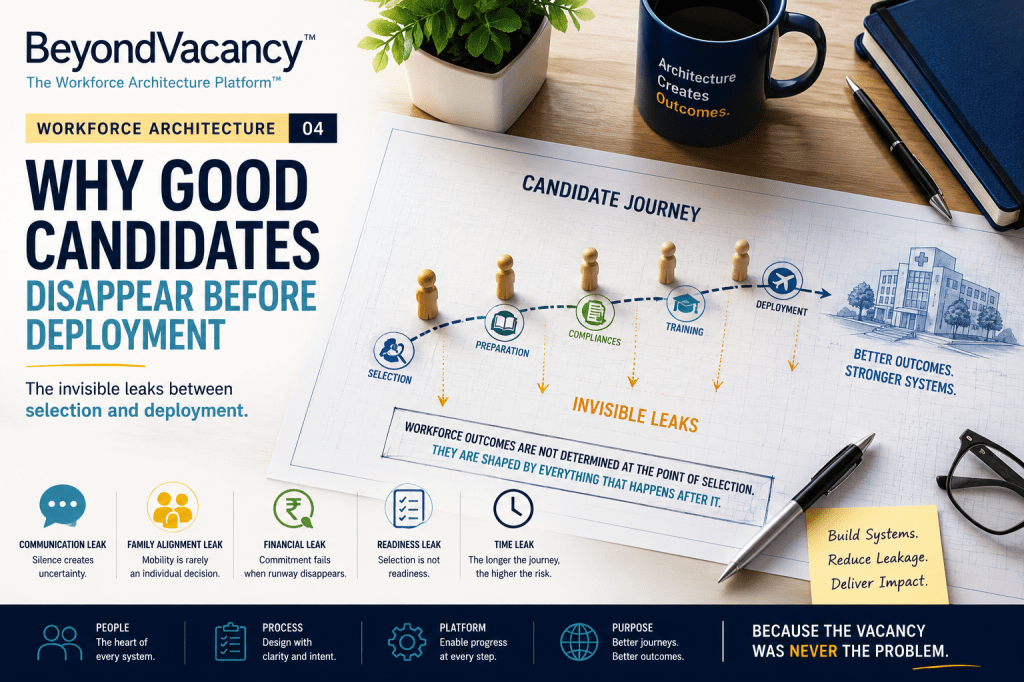
For years, we have treated recruitment as the mechanism that turns people into workforce. It doesn’t. Recruitment can identify, attract and select people. What happens before and after recruitment determines whether that human capability actually becomes productive, sustainable workforce. Education creates capability. Policy shapes access. Mobility creates movement. Recognition creates eligibility. Readiness creates fit. Deployment creates capacity. Retention determines whether that capacity lasts.
The distance between “talent exists” and “workforce works” is where architecture lives.
That is why Workforce Architecture™ cannot be reduced to headcount planning or faster hiring. It asks a more difficult question: What has to be true for human capability to become sustainable workforce capacity? Once we ask that, the conversation changes. We stop looking only for more people and start examining the friction preventing the people we already have from becoming part of the workforce we need.
Perhaps the next workforce strategy should not begin with “Where will we find more talent?” Perhaps it should begin with something far more uncomfortable:
“Why isn’t the talent we already have becoming the workforce we need?”
That is the territory BeyondVacancy™ exists to explore.
Because people are the potential. Systems determine whether that potential becomes workforce.
BeyondVacancy™ — The Workforce Architecture Platform
Workforce Architecture™ 05 | BeyondVacancy™


Leave a comment