Why candidate attrition is often a symptom, not the problem—and what workforce architecture reveals about the journey between selection and deployment.
Every workforce ecosystem eventually loses someone it thought it had already secured.
The interview was successful.
The offer was accepted.
The documents were progressing.
The employer was waiting.
The candidate was committed.
Then, somewhere between selection and deployment, the journey quietly ended.
No dramatic event.
No formal withdrawal.
Just silence.
The industry calls this candidate attrition.
Workforce Architecture™ calls it something else:
Leakage.
Because candidates rarely disappear in a single moment.
They disappear through a series of small failures that nobody owns, and everybody pays for.
The Wrong Question
When a candidate exits the process, the industry often asks:
“Why did the candidate leave?”
It sounds like a reasonable question.
It is also the wrong one.
The question assumes the candidate is the primary source of failure.
But what if the candidate was simply the last visible symptom of a much larger problem?
What if the real failure occurred long before the candidate stopped responding?
What if the architecture failed first?
Selection Is Not Commitment
Many workforce systems treat selection as the finish line.
In reality, selection is often the starting point.
A candidate who accepts an offer has not completed the journey.
They have merely entered it.
Between selection and deployment exists a period filled with uncertainty, preparation, waiting, documentation, approvals, conversations, expectations, and life itself.
This phase can last weeks.
Sometimes months.
This is where workforce systems either strengthen commitment or slowly erode it.
The Invisible Gap
Most workforce systems are designed to acquire candidates.
Very few are designed to retain them.
The result is not attrition.
The result is leakage.
Candidates enter the process with:
- Hope
- Ambition
- Motivation
- Family support
- Career aspirations
Over time, they encounter:
- Delays
- Uncertainty
- Financial pressure
- Competing opportunities
- Conflicting advice
The candidate may not have changed.
Their environment has.
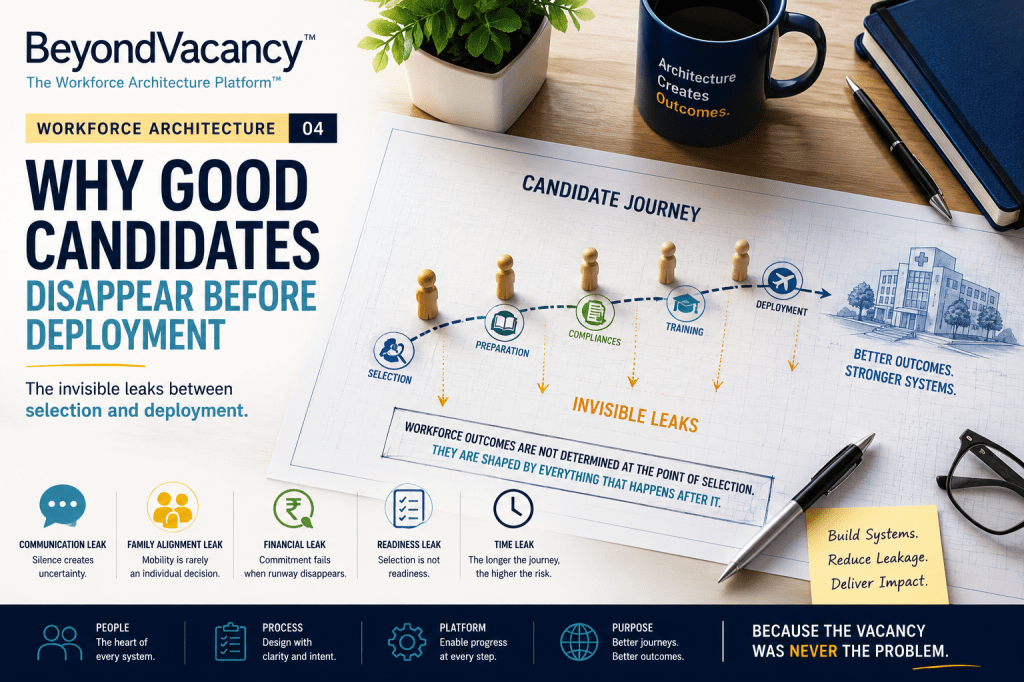
The Five Leaks in the Pipeline
1. Communication Leak
Humans can tolerate difficult news.
What they struggle to tolerate is uncertainty.
When communication becomes irregular, candidates begin filling information gaps with assumptions.
Silence creates doubt.
Doubt creates hesitation.
Hesitation creates disengagement.
Many candidates disappear because communication disappeared first.
2. Family Alignment Leak
Workforce mobility is rarely an individual decision.
It is often a family decision disguised as an individual one.
Parents.
Spouses.
Children.
Siblings.
Communities.
Every voice influences commitment.
A candidate may remain willing.
The ecosystem around them may not.
When family alignment weakens, workforce commitment often follows.
3. Financial Leak
International mobility is expensive.
Language preparation.
Documentation.
Licensing.
Travel.
Time away from income.
Extended waiting periods.
Many candidates do not leave because they lose interest.
They leave because they run out of runway.
What appears to be attrition is sometimes financial exhaustion.
4. Readiness Leak
Selection is not readiness.
A candidate may be selected without being fully prepared.
Readiness includes:
- Language readiness
- Clinical readiness
- Documentation readiness
- Cultural readiness
- Emotional readiness
- Family readiness
When readiness falls behind expectations, confidence begins to erode.
And confidence is often the first thing a workforce system loses.
5. Time Leak
Time is one of the least discussed risks in workforce mobility.
The longer the process takes, the more variables enter the equation.
New jobs emerge.
Family circumstances change.
Financial realities evolve.
Priorities shift.
Candidates do not live in suspended animation while systems move slowly.
Life continues.
Every additional month introduces additional risk.
The Industry Mistake
When candidates disappear, organisations often conduct a post-mortem focused on individual decisions.
The analysis usually sounds like this:
- The candidate changed their mind.
- The candidate lacked commitment.
- The candidate accepted another offer.
- The candidate became unresponsive.
All of these statements may be true.
None of them explain why.
The deeper question is:
What conditions made leaving easier than staying?
One question assigns blame.
The other examines architecture.
What Workforce Architecture™ Sees
Workforce Architecture™ views retention differently.
It recognizes that retention does not begin after employment.
Retention begins long before deployment.
The journey itself is part of the workforce system.
A workforce architecture that focuses only on sourcing and selection measures activity.
A workforce architecture that focuses on readiness, engagement, communication, confidence, and continuity measures outcomes.
Because people do not move through processes.
People move through experiences.
The Cost Nobody Measures
When a candidate disappears:
The employer loses predictability.
The recruiter loses momentum.
The workforce plan loses stability.
The healthcare system loses capacity.
The candidate loses an opportunity.
Everyone pays.
Most organisations simply do not calculate the bill.
They measure vacancies.
They measure interviews.
They measure offers.
They rarely measure leakage.
Closing Reflection
Good candidates rarely disappear in a single moment.
More often, they disappear through a series of small gaps that nobody owns, nobody measures, and everybody pays for.
The candidate was simply the final visible point of failure.
The architecture failed first.
Because workforce outcomes are rarely determined at the point of selection.
They are determined in everything that happens after it.
And perhaps that is the wrong question the industry has been asking all along.
The question is not:
Why did the candidate leave?
The question is:
Why was staying harder than leaving?
Part of the BeyondVacancy™ Journal
Workforce Architecture 04
BeyondVacancy™ exists to explore the systems behind workforce outcomes through Workforce Architectures™, Dispatches™, Workforce Intelligence™, Future Voices™, and Contributor Notes™.
The vacancy was never the problem.


Leave a comment