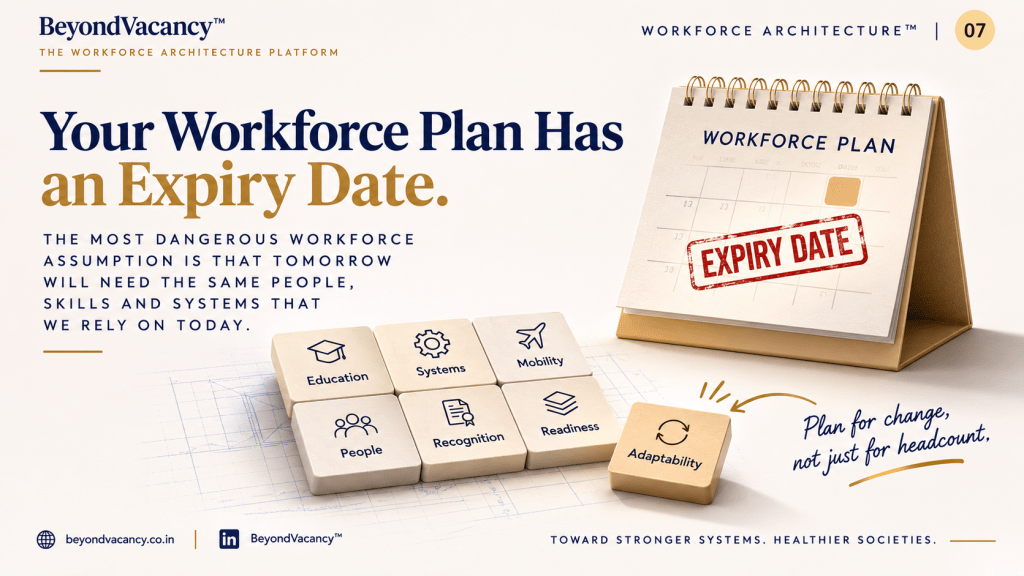
The most dangerous workforce assumption is that tomorrow will need the same people, skills, and systems that we rely on today.
The festivities are over. The lights have come down, and life is returning to its familiar rhythm. But the world outside hasn’t paused. Markets move, technology evolves, demographics shift, and the demands placed on organisations keep changing. We spend weeks preparing for a festival that hasn’t arrived. How often do we prepare our workforce for a future that is already taking shape?
Across FMCG, Telecom, E-commerce and Healthcare, I have noticed a recurring pattern. Organisations are remarkably good at planning for what they know. They forecast volumes, calculate headcount, approve budgets, identify vacancies and establish recruitment targets. There is nothing wrong with this. The difficulty begins when we mistake a forecast for preparedness.
Consider a hospital planning its nursing requirements around current patient volumes, staffing levels and anticipated attrition. What happens when specialist care requirements increase, experienced professionals retire, or international mobility regulations change the availability of talent? The workforce plan may still be perfectly reasonable. It may simply be answering a question that no longer reflects the reality the hospital must prepare for.
This isn’t exclusive to healthcare. Technology is changing roles, demographics are influencing talent availability, economic conditions are reshaping labour markets, and professionals are reconsidering their careers and mobility. Yet many workforce decisions remain anchored to assumptions that are revisited only when a vacancy, shortage, or operational disruption forces a review.
A workforce plan can be perfectly accurate about today’s requirements and still leave an organisation unprepared for tomorrow.
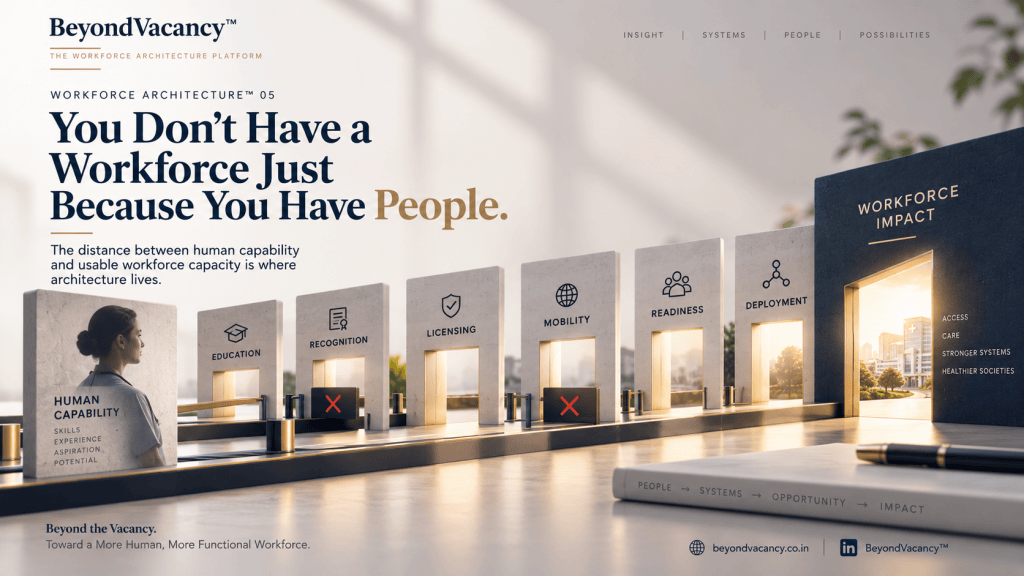
This is where we need to move beyond headcount planning. A workforce is not simply a collection of positions to be filled. It is an interconnected system of human capability, education, professional recognition, regulation, mobility, readiness, deployment and retention. A recruitment challenge may actually be a licensing bottleneck. A shortage of specialist skills may have originated in an education gap years earlier. A mobility constraint may expose an overdependence on one geography. What appears to be a sudden shortage may have been developing quietly across several interconnected systems.
We usually notice these failures only when they become operationally visible. We search for more candidates when capability is constrained, accelerate recruitment when professional recognition is the obstacle, and explore alternative markets when an established talent corridor becomes inaccessible. We address the visible consequence without necessarily examining the architecture that produced it.
This is why workforce planning and Workforce Architecture™ are not interchangeable. Planning estimates requirements and allocates resources. Architecture examines the conditions, relationships, and dependencies that determine whether those requirements can actually be met—and whether the resulting workforce can remain sustainable as circumstances change.
For a healthcare employer, this means looking beyond how many nurses will be required next year. It means understanding where they will come from, whether their qualifications will be recognized, how long mobility will take, what support they will need to integrate, and what will make them stay. It also means having alternatives when one of those pathways changes. The objective isn’t to predict every disruption. It is to build a system capable of responding without repeatedly starting from scratch.
And this brings us to a larger challenge. Employers, educational institutions, regulators, policymakers, and mobility partners all influence whether talent becomes available, deployable, and sustainable. Yet each often operates within its own priorities, timelines and measures of success. The decisions shaping tomorrow’s workforce are interconnected, but the systems making those decisions frequently remain fragmented.
The future does not wait for an organisation to update its workforce plan.
Perhaps we should stop asking only how many people we will need and start examining whether the systems around us will be capable of producing the workforce we need. Because the next workforce shortage may not begin with a resignation or a vacancy. It may begin years earlier, with decisions made across education, policy, mobility and employment that were never designed to work together.
And that leaves us with a question worth exploring next: if no single organisation controls all the conditions that shape a workforce, who actually owns its architecture?
That is where our next conversation begins.
BeyondVacancy™
The Workforce Architecture Platform
Sachin Sud
Founder, BeyondVacancy™


Leave a Reply